Technology has changed a lot of things. A quick look at daily life makes that clear: shopping habits have shifted, services have moved online, and both retail and e-commerce now rely on digital tools that shape how people compare options, place orders, and manage payments.
Personal habits have changed as well, especially in activities that once depended fully on physical venues, as we can see from the casino industry. In the Netherlands, for example, many players now prefer the so-called casino no IDIN platforms because digital access has altered how this activity is practiced.
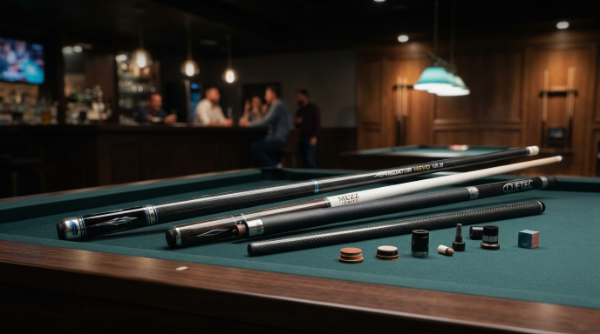
Pool has followed a different path, however. The game still belongs at the table, in clubs, halls, and practice rooms, yet the equipment itself has changed in meaningful ways. Cue makers have refined materials, taper designs, joint systems, and shaft technology to improve accuracy, reduce cue ball deflection, and give players more control under pressure.
For serious players, these changes are practical rather than cosmetic. The right innovation can affect spin transfer, consistency, feedback, and long-session comfort.
Low-Deflection Shafts Changed Competitive Play
One of the most important cue developments in recent decades is the low-deflection shaft. Traditional shafts tend to push the cue ball slightly off line when side spin is applied.
Skilled players learn to compensate, but the amount of adjustment can vary by shaft design. Low-deflection models reduce that sideways movement, making cue ball paths more predictable when using side spin.
Construction methods explain much of the difference. Many low-deflection shafts use lighter front-end mass, radial consistency, and internal engineering that keeps the hit firm without adding excess squirt. For a serious player, the main benefit is repeatability. The less guesswork required on side-spin shots, the easier it becomes to trust patterns and maintain rhythm during matches.
Carbon Fiber Shafts Brought Consistency to a New Level
Carbon fiber shafts moved cue design forward again by solving problems that wood could never fully eliminate.
Wood reacts to climate, can warp over time, and varies slightly from one shaft to another. Carbon fiber is far more stable. It resists moisture, holds its shape, and delivers a very uniform feel from cue to cue.
Feel was once the main objection. Early carbon fiber shafts could seem too stiff or muted to players used to maple. Newer versions are more refined. Manufacturers now tune wall thickness, foam filling, and front-end construction to improve feedback. As a result, players can get carbon fiber's durability and precision without losing the touch needed for finesse shots, soft draws, and delicate safety play.
Joint Systems and Pin Designs Improved Feedback
The joint is where two parts of the cue meet, but its role goes beyond simple assembly. Joint material, pin type, and fit all influence hit, vibration transfer, and balance.
A steel joint often produces a firmer, sharper response. Wood-to-wood joints tend to feel softer and more connected. Quick-release systems add convenience, while traditional radial or Uni-Loc designs focus on alignment and consistency.
Players often notice this most on center-ball shots. A cue with a well-matched joint gives a more complete sense of contact, which helps with speed control. For example, some players prefer a radial pin because it creates a solid, even connection and reduces the chance of minor alignment inconsistency. Others favor quick-release systems for ease of setup during regular league travel.
These choices are personal, yet they still count as meaningful innovations because manufacturers now design joints with performance goals in mind instead of using a single standard across all models. The result is a wider range of cues built for different stroke tempos, preferences, and feedback styles.
Balance and Weight Systems Became More Precise
Older cues often offered limited adjustment. Today, many quality cues include modular weight bolt systems that let players fine-tune total mass and balance point.
That may seem minor until a player tests two cues of the same weight with different distribution. One may feel heavy in the rear and slow through the ball, while another may move more naturally through the stroke.
Serious players benefit because setup can match technique more closely. A player with a long, smooth delivery may want a different balance than someone with a compact punch stroke.
Balance also affects fatigue. During long practice sessions, a cue that carries its weight efficiently is easier to manage. That leads to cleaner mechanics late in the session, when small errors often appear. For competitive players, that is a real performance advantage, not just a comfort feature.
Customization and cue fitting matter more than ever
The best innovation is not always a single material or feature. In many cases, it is the ability to fit a cue more precisely to the player.
Diameter options, taper profiles, butt thickness, wrap style, tip hardness, and weight distribution can now be tailored with far more detail than before. This has made cue buying less about brand loyalty alone and more about measurable compatibility.
That level of choice has raised the standard for serious equipment decisions. Players no longer need to settle for a cue that is merely good in general terms. They can select one that supports how they actually play. For anyone committed to improving at the table, modern cue innovation proves its value most clearly.
 English
 Español
 Portugués
 Français
 Italiano
 Deutsch
 Nederlands